

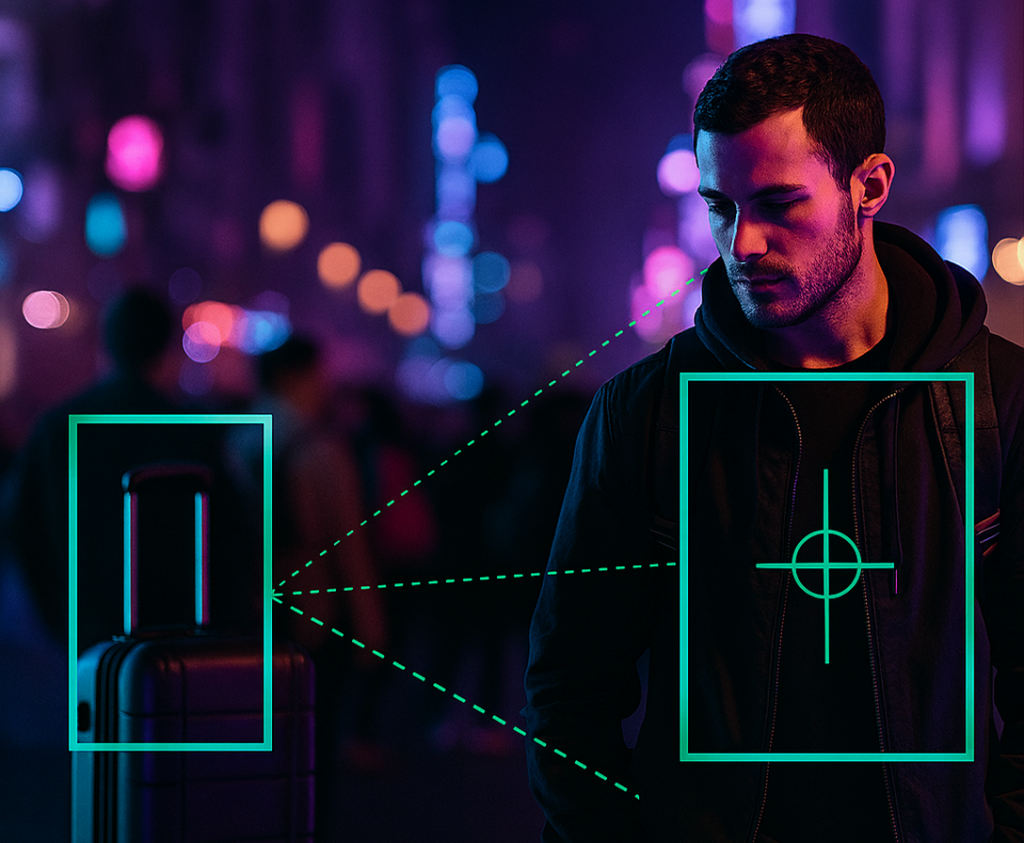
High-Precision Object & Human Tracking has become one of the most critical capabilities in modern AI-driven surveillance. As environments grow denser and lighting conditions become more complex, traditional camera systems can no longer deliver the accuracy, reliability, and situational awareness required for real-world security and operational monitoring. Crowded public spaces, industrial facilities, transportation hubs, and low-light environments demand intelligent systems that can see, understand, and react in real time.
This is where advanced AI-powered tracking systems, such as those developed by SeeDeep.ai, redefine what is possible in real-world video analytics.
Why Crowded and Low-Light Environments Are the Hardest to Monitor
Visual Occlusion in High-Density Spaces
In crowded environments, people and objects constantly block each other from view. Traditional systems struggle to maintain identity tracking when subjects overlap, change direction, or move across multiple camera fields. High-precision tracking must preserve continuity even during partial or full occlusion.
Low-Light Conditions Reduce Visual Reliability
Warehouses at night, parking facilities, perimeter zones, and industrial plants often operate under poor lighting. Noise, motion blur, glare, and shadow distortion significantly degrade conventional detection systems.
Dynamic Movement Patterns
Crowded scenes produce irregular motion—sudden stops, direction changes, and unpredictable interactions between humans and machines. These behaviors require advanced motion modeling rather than simple frame-by-frame detection.
What High-Precision Object & Human Tracking Really Means
High-Precision tracking goes far beyond basic detection. It combines:
- Persistent identity tracking over time
- Trajectory prediction
- Multi-object differentiation
- Context-aware motion analysis
- Robust re-identification after occlusion
- Accurate performance in poor lighting
Unlike simple motion detection, this level of tracking understands who is moving, what is moving, how it is moving, and why the movement matters.
How AI Enables Reliable Tracking in Difficult Conditions
Deep Learning-Based Feature Extraction
Modern tracking engines use deep neural networks to extract unique visual signatures from humans and objects. These include:
- Body shape
- Gait patterns
- Clothing contours
- Object geometry
- Movement rhythm
These features remain stable even when the subject partially disappears behind obstacles.
Temporal Memory and Identity Persistence
AI models maintain a short-term and long-term memory of tracked entities. Even if an individual vanishes behind a vehicle or wall, the system can accurately reassign the same identity once they reappear.
Low-Light Image Enhancement
Advanced video processing pipelines apply noise reduction, contrast enhancement, and adaptive exposure correction before detection occurs. This allows accurate tracking in near-dark environments without requiring expensive new cameras.
Multi-Object Tracking in Complex Scenes
Simultaneous Tracking of Humans, Vehicles, and Equipment
High-precision systems track dozens or hundreds of entities at once, including:
- Pedestrians
- Vehicles
- Heavy machinery
- Mobile equipment
- Unauthorized objects
Each class of object follows different behavioral rules and motion patterns.
Behavioral Context Modeling
Tracking is not only about location. AI models analyze:
- Speed variations
- Directional intent
- Stop-and-go behavior
- Proximity to restricted zones
- Unsafe human-machine interactions
This enables early identification of abnormal or risky behavior.
For a deeper understanding of how intelligent object tracking and behavioral analysis work together in real-world environments, you can explore our detailed guide on AI-powered tracking systems.
Tracking Accuracy in Low-Light Environments
Low-light tracking introduces extreme computational challenges. Advanced systems overcome these with:
- Infrared-compatible modeling
- AI-based denoising
- Shadow-aware segmentation
- Adaptive object contour extraction
- Motion-compensated tracking
The result is stable tracking even when the human eye sees very little detail.
High-Precision Tracking Across Multi-Camera Networks
Cross-Camera Identity Matching
In large facilities, individuals move between dozens of cameras. High-precision AI tracking preserves identity across different viewpoints, angles, and lighting conditions.
Unified Spatial Awareness
The system merges all camera feeds into a single spatial intelligence layer. This allows operators to follow a subject across the entire facility without losing context.
Continuity in Crowded Transitions
At entrances, corridors, elevators, and chokepoints, identity handoff between cameras remains seamless—even in heavy foot traffic.
Real-Time Performance Without Latency
Tracking accuracy is meaningless without real-time response. Advanced AI systems operate with:
- GPU-accelerated pipelines
- Edge-based inference
- Sub-second detection-to-alert latency
- Continuous frame-level analysis
This allows immediate reaction to incidents such as:
- Unauthorized entry
- Suspicious loitering
- Asset removal
- Unsafe proximity events
Industrial and Urban Use Cases
Smart Cities & Public Safety
- Crowd density measurement
- Pedestrian flow monitoring
- Suspicious behavior tracking
- Traffic and intersection analytics
Warehouses & Logistics
- Asset tracking
- Forklift and worker safety
- Loss prevention
- Unauthorized access detection
Manufacturing & Heavy Industry
- Machine-area intrusion detection
- Worker compliance monitoring
- Accident prevention
- Equipment movement analysis
Transportation Hubs
- Platform crowd control
- Passenger flow optimization
- Security perimeter protection
- Object left-behind detection
Why High-Precision Tracking Outperforms Traditional Surveillance
Traditional CCTV relies on human observation and basic motion alerts. High-precision AI tracking delivers:
- Continuous identity awareness
- Predictive risk detection
- Automated alert generation
- Full behavioral analysis
- Rich operational data for decision-making
Instead of reacting after incidents occur, organizations gain the ability to prevent risk before it becomes damage.
The Role of SeeDeep.ai in High-Precision Tracking
SeeDeep.ai integrates high-precision object and human tracking into a unified video intelligence platform designed specifically for real-world complexity. The system combines:
- Deep learning-based detection
- Multi-object tracking
- Behavioral modeling
- Low-light optimization
- Multi-camera intelligence
- Real-time alerting and analytics
This enables consistent performance across crowded urban zones, industrial plants, and low-visibility environments without hardware replacement.
Data-Driven Insights Beyond Security
Tracking data is not only used for safety. It also provides:
- Operational optimization
- Workforce analytics
- Traffic flow optimization
- Resource planning
- Facility layout improvement
By converting raw video into structured intelligence, organizations unlock long-term strategic value.
The Future of Tracking in Challenging Environments
As AI models evolve, tracking systems will move toward:
- Predictive movement modeling
- Autonomous anomaly interpretation
- Behavioral risk scoring
- Self-learning tracking policies
- Deeper integration with smart infrastructure
High-Precision Object & Human Tracking is rapidly becoming a foundational layer of intelligent environments.
Conclusion: Precision Is No Longer Optional
High-Precision Object & Human Tracking in crowded and low-light environments is no longer a luxury—it is a necessity. As operational complexity grows, organizations need systems that can see clearly where humans cannot.
By combining AI, computer vision, real-time analytics, and behavioral intelligence, platforms like SeeDeep.ai deliver reliable tracking even in the most demanding conditions. The result is safer environments, smarter operations, and a higher level of situational awareness that traditional systems simply cannot achieve.